
Return to the village Front Page
Over the centuries many interesting people have lived in our village, and have given it much of its character. This page has notes on a few of those we know about. We hope that more will be added as time goes by. If you have suggestions and relevant material, we'd be glad to hear from you.The list below is in alphabetical order of surname, to make reference easy.
Allen
Stafford Allen set up a farm and factory on the outskirts of Long Melford in 1899 to make natural pharmaceuticals, condiments and perfumes by milling herbs and spices, many of them grown on the spot. These included belladona, digitalis, liquorice and peppermint. The factory also milled imported ginger and pepper, a variety of gums and other spices, and made food flavouring essences (butter, almond, honey-cream and madeira) and naturally-based insecticides such as pyrethrum and derris.The business flourished, and the association with the Allen family has continued for a hundred years. It is now "Bush Boake Allen" and until 2002 made the most wonderful smells in the village street when the wind was in the right direction! Now, taken over by International Flavours and Fragrances Ltd. the plant has been closed down.
Almack
Richard Almack was a successful lawyer in the village during the 19th century, and for many years Clerk to the Council. He was a founder member of the Society of Antiquaries, and had a big influence on the restoration of the Church (Holy Trinity), and in particular the stained glass.Ambrose
Ernest Ambrose (1878-1972) lived in Long Melford all his life, and wrote his memoirs as "Melford Memories", a book (long out of print) that is now very greatly valued by everyone interested in recent village history. Ernest Ambrose worked in Whittle's coconut matting factory for many years, and was a footballer, chorister, organist and bell ringer. He is perhaps best known of all for his photographs, which form a remarkable record of village life over many years in the early 20th century. The negatives of many of his pictures are now in the care of the Long Melford Historical and Archaeological Association.Bisbie
(Doctor) Nathaniel Bisbie (1635-1695) was Rector of the parish of Long Melford from 1660 to 1690. He was ejected from his post for not swearing allegiance to William the Third after the expulsion of James the Second. He kept very detailed accounts of the parish (which have survived), listed the inhabitants, and recorded some of Melford's earlier history, including Roger Martin's account of the church before the protestant reformation.Blunden
Edmund Blunden (1896-1974), one of the great poets of the First World War, lived in Hall Mill, Long Melford for the last ten years of his life. Born in London and brought up in Kent, he served with the Royal Sussex Regiment in France from early 1916 to the end of the war. He fought at the Somme and at Ypres, and was awarded the Military Cross for bravery during the battle of the Somme. He wrote several volumes of poetry, including "The Shepherd ", published in 1922, which includes his poem "Third Ypres" about the Battle of Paschendaele, and a large number of books, articles and reviews. He taught English Literature at Tokyo in the 1920s and was a Fellow of Merton College, Oxford from 1931-1944. Later, in the 1950s he taught at Hong Kong. He was elected Oxford Professor of Poetry in 1966, but had to give up the post through ill-health in 1968. He is buried in the churchyard of Holy Trinity, Long Melford.Clopton
William Clopton (1383-1446) inherited Kentwell at the age of twenty from his mother, who had owned it before she was married. He fought at the battle of Agincourt (1415) for Henry the Fifth of England against France, and started the rebuilding of the great church at Long Melford before he died in 1446.John Clopton (1423-1497), son of William Clopton, was a close friend of the Earl of Oxford, and was arrested with him in 1461 for treason and imprisoned in the Tower of London. (It was the height of the Wars of the Roses, and Edward of York had just seized the English throne, so "treason" here means loyalty to the previous regime.) The Earl and his son were executed, but John Clopton was released, and returned to Kentwell. Shortly afterwards he extended his father's work on the north side of the church, and later became the chief organiser, fund raiser and benefactor of the church rebuilding scheme. The church was finished in 1496, (more or less as we see it today) and John Clopton is buried there between the Clopton Chapel and the Sanctuary.
The Clopton family owned and developed Kentwell for many generations, and built much of the Kentwell Hall that can be seen today. The family is still quite numerous in the USA, and there is a Clopton family web site which is worth a visit.
Cordell
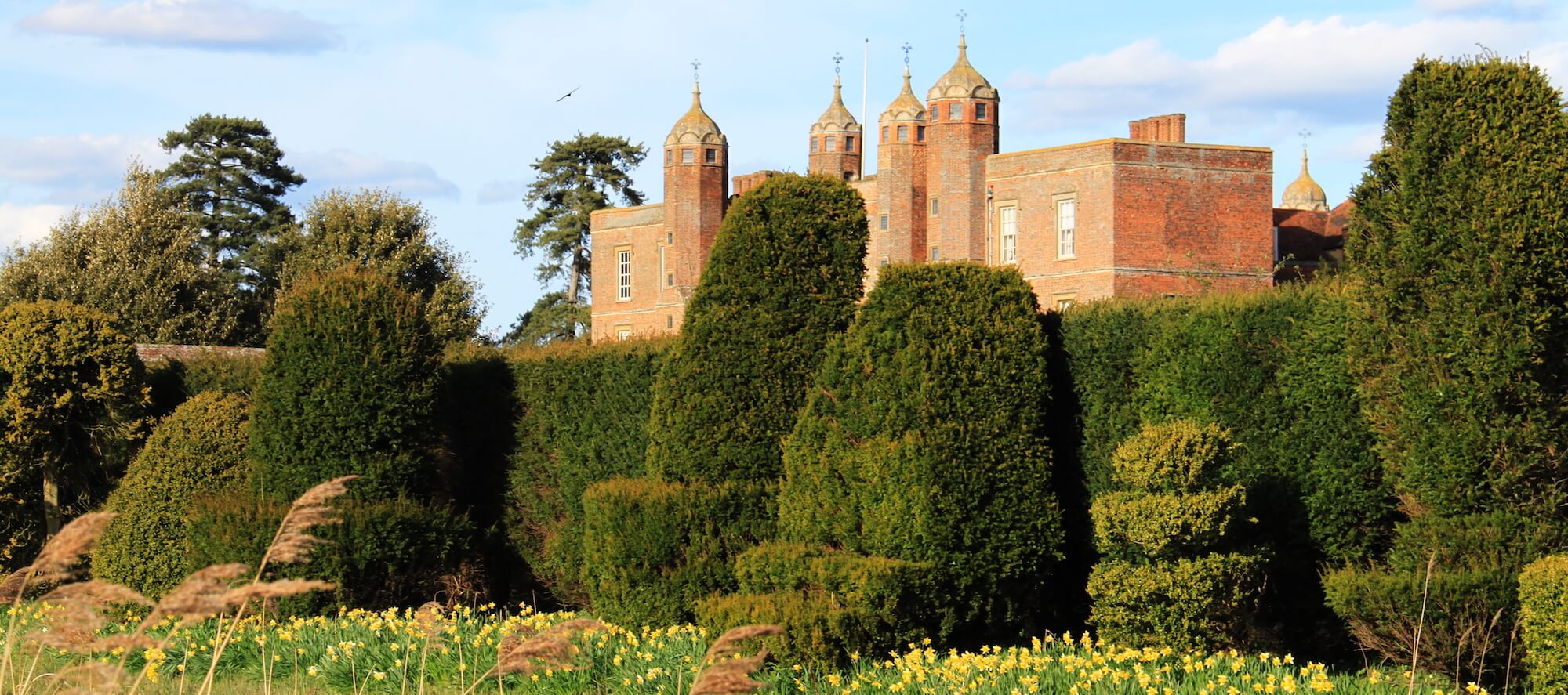
(Sir)William Cordell leased the manor of Melford Hall in 1547 for £100 a year, and acquired it outright from Queen Mary in 1554. He was a lawyer deeply involved in public affairs who eventually became Solicitor General and later was Master of the Rolls. He was knighted and became MP for Suffolk, and Speaker of the House of Commons. He must have been a remarkable man, as he served King Henry the Eighth and each of his children in turn, through all the political and religious turbulence of the Tudor period.In Long Melford he built the "Trinity Hospital" on the green in front of the church as an almshouse for twelve poor men and a warden from the village. In 1578 Sir William entertained Queen Elizabeth at Melford Hall in the grandest style, setting an (expensive) example to the rest of Suffolk. He died in 1581, leaving a widow but no children, and the Melford Hall estate passed to the Savage family.
John Cordell, a distant cousin of Sir William, recovered and restored Melford Hall in 1650 after its plunder by a mob in 1642 and subsequent ruin. He had provided a mortgage on it to Countess Rivers who became a target for anti-catholic and anti-royalist feeling. (She died in poverty in 1650)
Drew
The Drew family were landlords of the Bull Inn for over 200 years. (The Bull is still the largest hotel in Long Melford). Another member of the family who lived in the village was shot dead on his own doorstep by his son in the 18th Century, a murder that caused a major sensation at the time.Hanwell
(Admiral) William Hanwell (1766-1830) was senior lieutenant of the Sheerness (44 guns), the flagship of Commodore James Cornwallis on the African station. The Commodore died of a fever on 31st July 1798, and Lieutenant Hanwell, now the senior officer, promoted himself two ranks higher to become a Post Captain. This amazing step could only have been legitimate on the African station, and was confirmed by the authorities when he returned to England at the end of the year.He married in 1800. His subsequent career seems not to have been distinguished, and after commanding two different vessels, in the last years of the wars against Napoleon he superintended the depot for prisoners of war at Norman Cross. In the course of time he reached the rank of Rear Admiral of the Blue Squadron., and died at his house (Hanwell House in Hall Street) in Long Melford in June 1830 at the age of 64.
Hyde Parker
The Hyde Parker family owned Melford Hall from 1786 until it was given to the National Trust in 1960. Many of them distinguished themselves in the Royal Navy, including several who rose to the rank of Admiral. Sir Richard Hyde Parker, the 12th Baronet, still lives in Melford Hall with his family today.Martin
Roger Martin Esquire (1526-1615) lived through the religious revolutions of the Tudor dynasty, and did his best to preserve and record the treasures of the great church (Holy Trinity). His family had owned Melford Place, a large house and estate to the south of the village since the 14th Century, and had been among the most generous benefactors of the church when it was rebuilt.Roger became Churchwarden in the reign of Mary I, and was very active in re-establishing Catholic worship (which had been prohibited during the previous six years, in the time of Edward VI). Under Elizabeth I (who reinstated protestant Anglicanism), he continued for some time to annotate parochial accounts, but he was marked down as a "recusant" (i.e. one who refused the Anglican rites) in 1574. Later he was fined £200 - an enormous sum in those days, and deprived of some of his income. He was imprisoned more than once for sheltering Catholic priests, and is said to have escaped pursuit on on occasion by hiding in a hayrick.
Late in his life he wrote "The State of Melford Church and Our Ladie's Chapel at the East End, as I Did Know It", a wonderful account of what the church looked like before the reformation, and what happened on many of the special occasions like Palm Sunday and Corpus Christi Day.
Roger Martin died in 1615 at the ripe age of 89, and is buried (in spite of his known catholicism) in his family's chapel in Holy Trinity Church, on the south side of the chancel, together with his two wives.
Martyn
The Revd. Charles Martyn (1836-1901) was Rector of Long Melford from 1868 to 1893. He is remembered as an energetic benefactor of the village, who supported many charitable causes, including the local Friendly Societies (at the start of the Cooperative movement). His wife died in 1882, and he built St Catherine's Church in the centre of the village in memory of her and so that the women from the south end of the village would not have to walk so far to church. (Holy Trinity at the top of the green is over a mile further north.) He was a Freemason, and became Deputy Grand Master for Suffolk, and was also appointed Chaplain-in-Ordinary to Queen Victoria.Seaman
Dick Seaman (1913-1939) was a racing driver famous for his success with the Mercedes-Benz team in the late 1930s, winning the German Grand Prix in 1938. Eleven months later he crashed at Spa and died. Born in Sussex, he lived with his parents at Kentwell Hall in Long Melford from 1915 to 1919, where he learned to drive a toy car round the grounds. He was later educated at Rugby and Trinity College Cambridge before taking up his career as a racing driver.Ward
David Ward established an iron foundry in Long Melford in 1843, together with his brother in law James Silver. It was on the East side of Hall Street, close to where Fleetwood Caravans are made today, and became an important business in the village, employing 63 men and 4 boys in 1881. There are many examples of cast iron fenders with Ward and Silver's name on them in Long Melford, and also several crosses in the northern part of the churchyard. David Ward was also one of the proprietors of the village gasworks, set up to provide street lighting in the days before electicity was an option.Westropp
The Westropp family and their descendants have farmed Melford Place (one of the three big estates in the village) since 1820.Anna Maria Westropp (nee Gardiner) was the widow of John Spalding, who owned Melford Place from 1802 to 1819. She married Charles Hanmer Westropp in 1820, and they had four sons. She died in 1858. Her husband died in 1864.
Charles Henry Westropp (1869-1942) farmed at Melford Place from 1895 till the 1930s and was a very successful horse and cattle breeder. His pony-drawn trap could cover a mile in 3 minutes and he regularly travelled from Melford Place to the Market Hill in Sudbury in only six minutes. (That is slightly faster than the bus would take you today!) What is more, the horse was not allowed to gallop, which would have been against the law, but went at a rapid trot. Mr Westropp was instrumental in setting up the herd registration system for dairy cattle, and the Melford Place Herd still has the very early herd number of 8 for its Holsteins. Charles Henry's great grandson, David Westropp Cutler, now runs the farm at Melford Place.